The correct tool depends on what the person retains: balance, arm strength, leg loading and understanding. How to choose between a board, belt, stand aid or lift.
Options for this need
Compare what each aid offers and who it may suit.
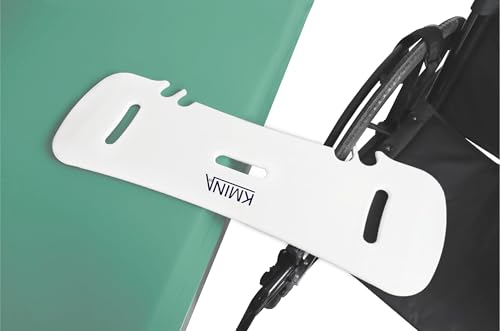
KMINA 76 cm transfer board
A good fit when: the person can cooperate and both surfaces are stable and at a similar height.
I would not choose it if: the person is passive, there is a large height difference or the board lacks adequate support.

Mobiclinic Fortuna Basic electric patient lift, up to 180 kg
A good fit when: a full-body supported transfer is required, the four-point sling is compatible and the base fits under the bed or chair.
I would not choose it if: a stand aid is required, the transfer route has not been measured or nobody has been trained to use it.
Affiliate links: we may earn a commission at no extra cost to you.
Assistive equipment does not replace clinical or occupational-therapy assessment when there is pain, a fall, a wound, sudden deterioration or an unsafe transfer.
How to make the decision
A rigid bridge for lateral transfers when the user retains arm strength and trunk control.
- Two stable surfaces at similar height
- Sufficient arm strength
- Previous training with a professional
The boundary not to cross
It is not for lifting a passive person or bridging a large height difference. The stated 100 kg limit requires margin and correct technique.
Seek clinical or occupational-therapy advice for new severe pain, an open wound, a recent fall, sudden weakness, breathing difficulty or inability to control head and trunk. An online guide cannot assess those risks remotely.
A note for the caregiver
Identifiable manufacturer, manual and 124 observed ratings. Keep the surface clean and inspect for cracks.
Continue refining your decision
Sources
- FDA — Patient Lifts Safety GuideSelección, compatible sling, inspección y uso seguro de grúas de transferencia.
- HSE — Moving and handling equipmentAssessment of the environment and equipment for moving and transfers.
- INSST NTP 1197 — Ayudas técnicas para la movilización de personasErgonomic criteria to reduce overexertion during moving and transfers.