All four feet must fit inside the tray while leaving space for access and assistance. Footprint, screen, height, arms, trunk control and capacity.
Options for this need
Compare what each aid offers and who it may suit.

PEPE Mobility shower chair with arms and back
A good fit when: the arms assist sitting and the outer width fits the shower and doorway.
I would not choose it if: a clear lateral transfer is needed or stability and maximum load have not been checked.
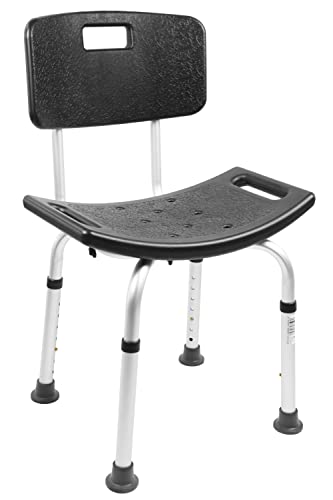
PEPE Mobility compact shower chair with backrest
A good fit when: the bathroom is narrow and a backrest is needed without side arms.
I would not choose it if: armrests are required to control sitting down or seat width does not fit.
Affiliate links: we may earn a commission at no extra cost to you.
Assistive equipment does not replace clinical or occupational-therapy assessment when there is pain, a fall, a wound, sudden deterioration or an unsafe transfer.
How to make the decision
An adjustable corrosion-resistant chair with removable arms, provided the full footprint fits the shower tray.
- A user able to remain seated
- At least 53 × 44 cm of usable shower space
- A need for arm support when sitting or rising
The boundary not to cross
Do not use if a foot sits outside the tray, the screen blocks access or the user lacks trunk control. The stated limit is 100 kg; retain a safety margin.
Seek clinical or occupational-therapy advice for new severe pain, an open wound, a recent fall, sudden weakness, breathing difficulty or inability to control head and trunk. An online guide cannot assess those risks remotely.
A note for the caregiver
IMD SL, manual available and a large review sample. Confirm the selected variant includes arms, back and the stated footprint.
Continue refining your decision
Sources
- Bathing and toileting equipment use and satisfactionReal-world use and satisfaction with bathing and toileting aids.
- WHO — FallsFall risk factors and prevention.